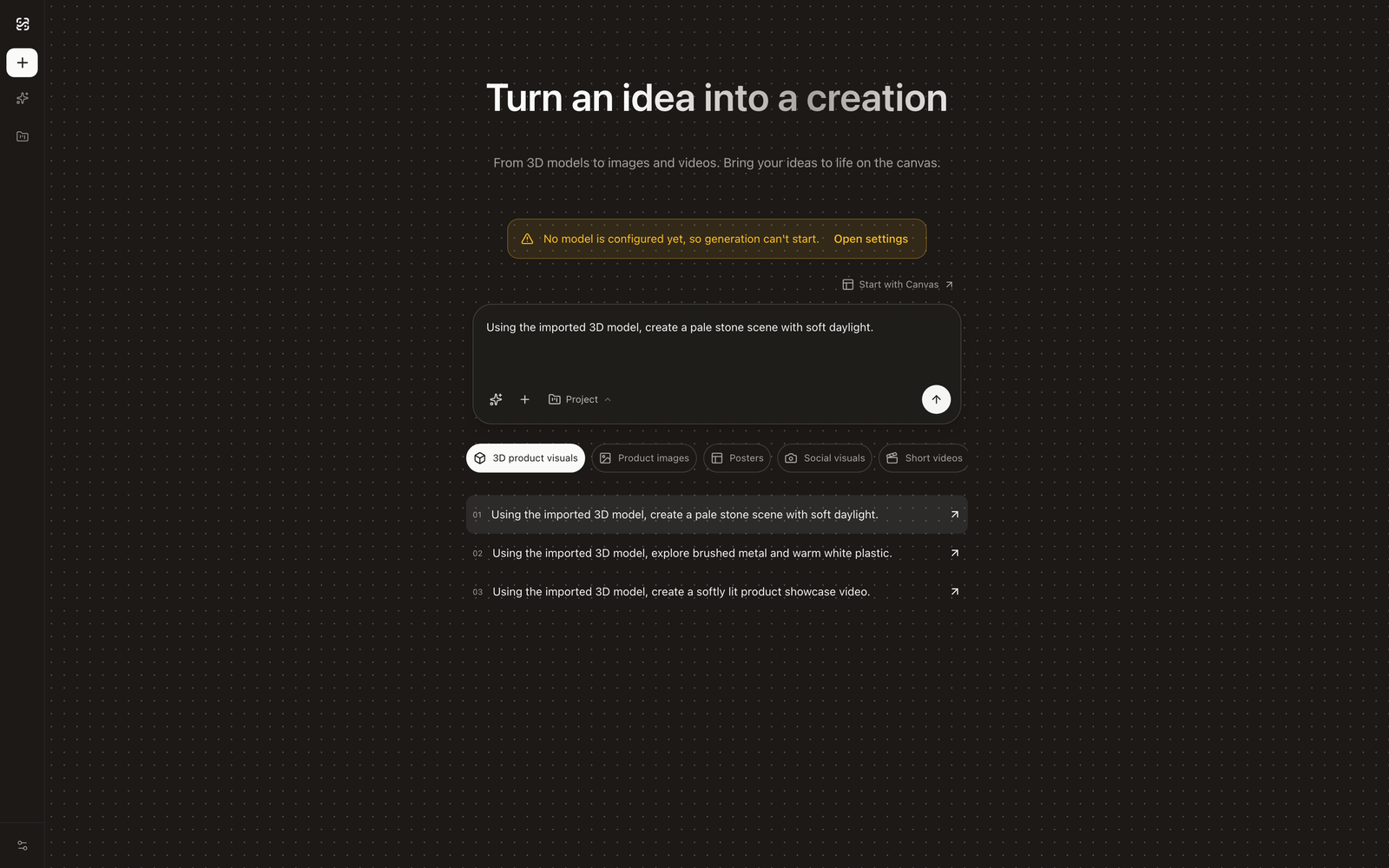
Yes — bring-your-own-key is exactly what it sounds like: the tool ships without a meter, and generation runs on the model API you already have or choose to buy. Your requests travel from the client straight to that provider, your billing is the provider’s own pricing with no markup, and switching models is a settings change instead of a migration. This page explains why that model wins for sustained product-image work, what it honestly costs you in convenience, and — because this isn’t a religion — when a credit pool is still the right answer.
How credit pools actually work
The dominant SaaS pricing model in AI product imagery is the credit pool: a monthly subscription grants N generation credits; each image, video, or upscale burns some; unused credits typically expire with the cycle; bigger pools cost more per month. It’s a familiar, predictable model — and understanding its economics explains why an alternative exists at all.
Three properties are structural, not incidental:
- The markup is the business. Credits price the underlying API compute plus the vendor’s margin, plus the free-tier acquisition costs, plus payment processing. You pay for all of it in every credit.
- Expiry converts your unused capacity into vendor revenue. A quiet month doesn’t bank images for a busy one; it just resets.
- The pool locks the menu. Which models you can call, at what quality tiers, at what effective per-image cost — all decided by the vendor. Model competition happens on their roadmap, not your settings.
None of this is a scam; it’s how the category prices convenience. BYOK is what the same economics look like without the convenience layer.
The BYOK account
With bring-your-own-key, the money path is short: you hold an account with a model provider (or several), the client stores your key locally, and every generation bills directly to that account at the provider’s published rates. What that buys:
No markup, no expiry. You pay the provider’s per-image or per-token price — the same rates any developer pays — and unused balance sits in your account, not in a monthly bucket. A quarter of heavy generation followed by a quiet month costs what it costs, nothing more.
Model freedom, including the future. Add any OpenAI-compatible channel: base URL plus key, or a preset — DeepSeek, Moonshot, MiniMax, Zhipu, OpenRouter, fal.ai. When a better image model ships next quarter, you point the same workflow at it the day it launches. A credit pool can only offer what its vendor has negotiated; your key offers what the market has.
Price visibility. Provider API pricing is public per model. Your actual per-image cost is a known number you can put in a spreadsheet — a calculation, not a subscription leap of faith, and a real input when comparing AI tools by what they cost at your volume.
Consistency across tools. A key that works here works in any other BYOK-capable tool. Your spend aggregates across your whole workflow instead of scattering into per-tool subscriptions.
A concrete shape for it: teams generating product imagery at catalog scale routinely run hundreds to thousands of images a month. At that volume the difference between provider rates and credit pricing compounds into the kind of number that finance notices — which is why BYOK behavior shows up first among heavy users.
What BYOK costs you
The honest column, because a comparison that flatters one side is worthless:
- You do the setup. Creating a provider account, funding it, pasting the key. Ten minutes, once — but ten minutes some people correctly don’t want to spend.
- You own the knobs. Rate limits, region availability, model deprecations: with a pool, the vendor absorbs these; with your key, you read the error and adjust.
- Spend management is yours. A runaway batch job burns your credit, not a capped pool. (Set provider-side spending limits; every major provider offers them.)
- Debugging shifts down a layer. “Why did this generation fail” can be a model-side issue you diagnose from API errors rather than a support ticket.
If that list reads like a hassle, the honest answer is: it is one, and paying someone to make it disappear is legitimate. That’s exactly what shotshot’s hosted tiers are — the client’s BYOK path stays fully functional regardless, so the convenience is a purchase, not a wall.
When a credit pool is the right call
- You generate rarely. A dozen images a month inside a cheap or free tier beats an API minimum.
- You hate configuration. A working default is worth real money to many people; that’s a valid utility calculation.
- Procurement prefers vendors. One invoice, one vendor relationship, no developer-shaped setup task — for some teams that’s not laziness, it’s policy.
The dividing line is volume and engagement: the more you generate, the more the markup costs and the more the setup amortizes. Casual users should happily stay in pools; sustained product work almost always crosses the line where BYOK wins.
The privacy dividend
BYOK isn’t only a pricing model — it rewires the data path. Requests go from the client directly to the endpoint you chose; the tool vendor has no key pool to hold and no copy of your prompts to store. For teams whose unreleased products can’t tour other people’s clouds, that architecture is the point, and the full breakdown — including the self-hosted endpoint option — is in Private AI Product Photos.
Frequently asked questions
The compressed version: BYOK bills at provider rates with no markup or expiry, works with any OpenAI-compatible service plus common presets, trades setup and ops responsibility for price and model freedom, and quietly improves your privacy posture. Volume decides which side of the trade you should be on. The expandable answers cover each.